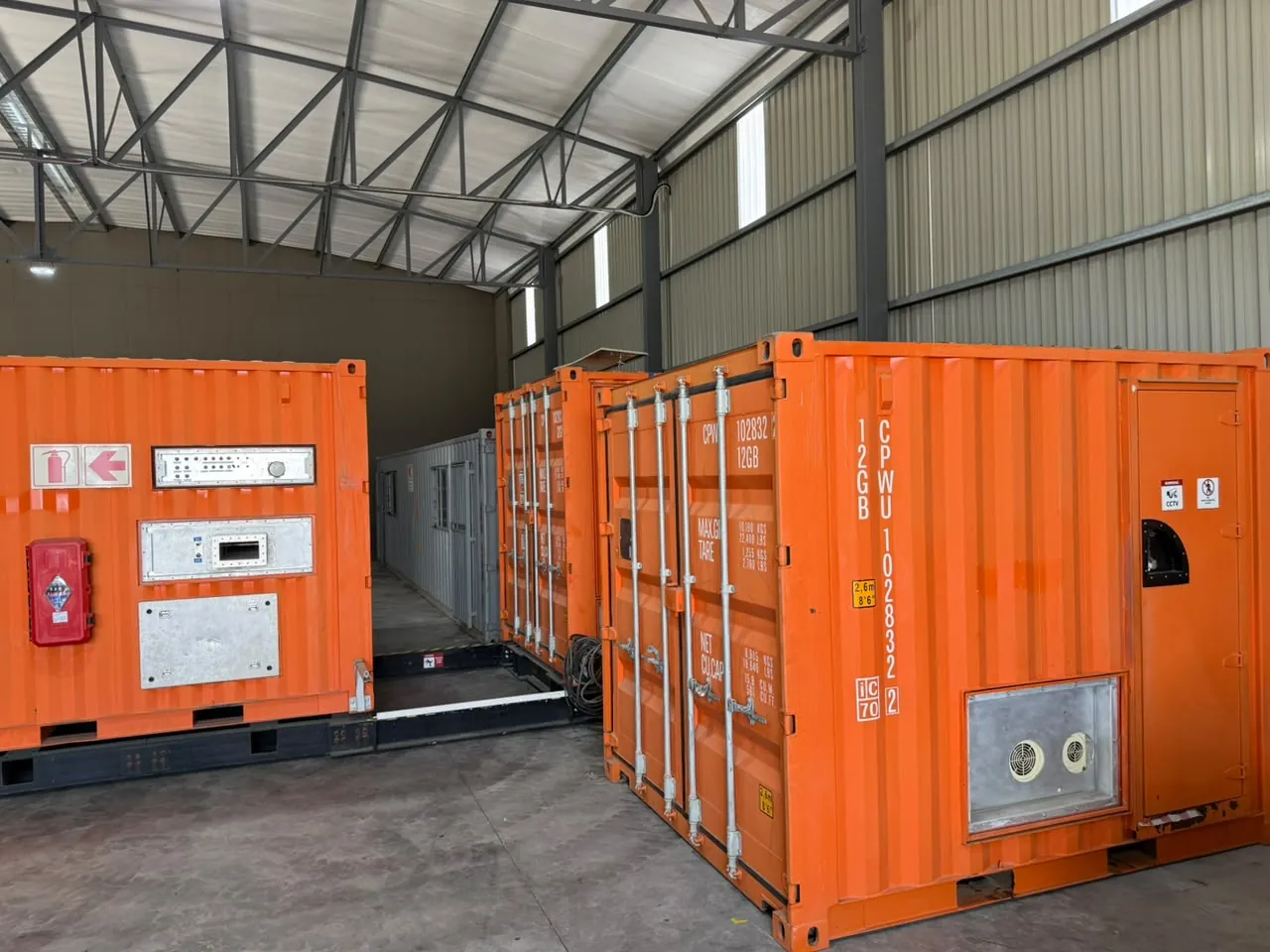
Microwave-Assisted Comminution: Benefits for Mineral Processing
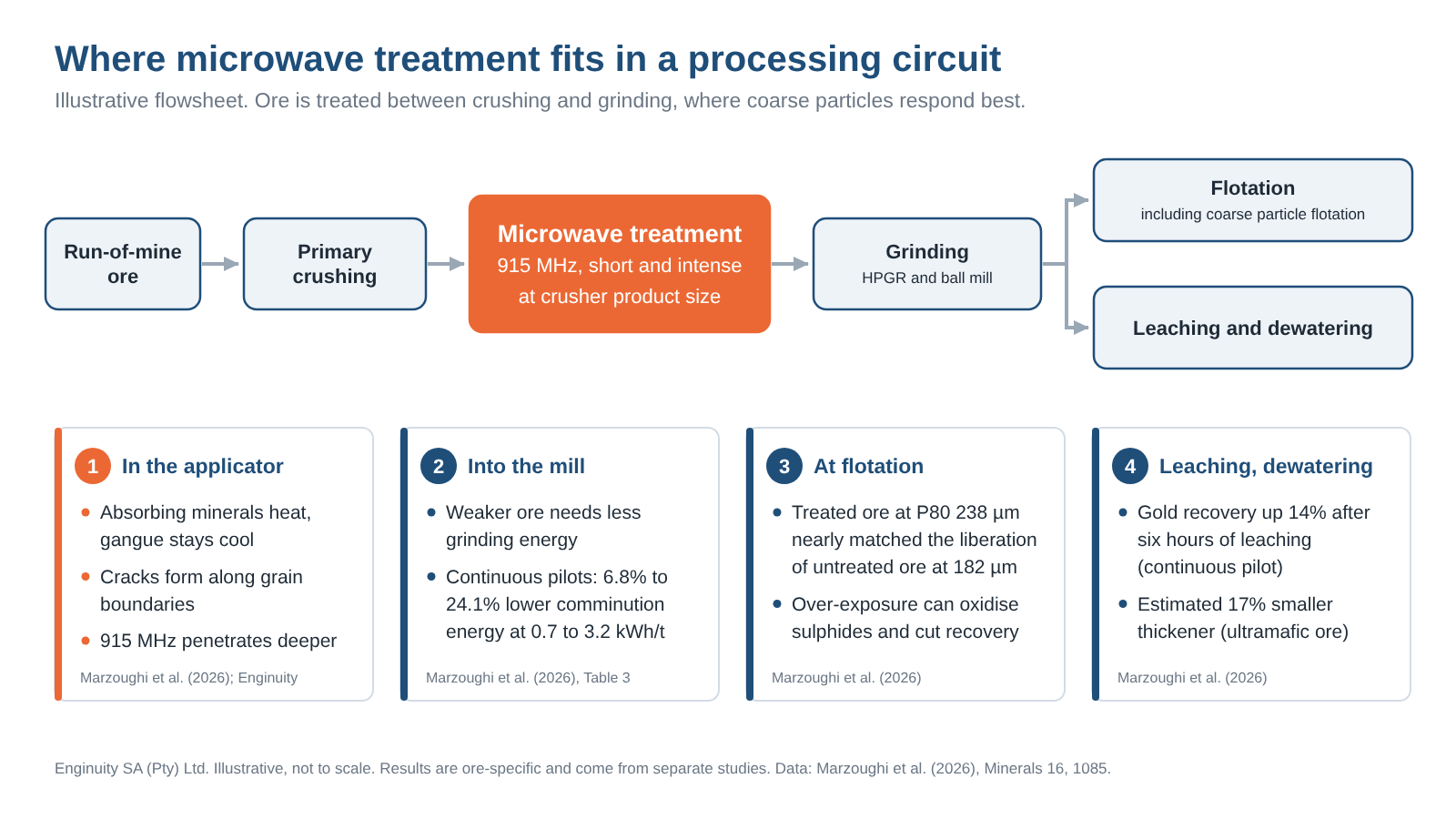
Microwave-assisted comminution heats ore briefly with intense microwave energy, ideally for a few seconds or less, before it is crushed and ground. Absorbing minerals such as sulphides heat quickly while most gangue stays cool, so the ore cracks along grain boundaries. Reported benefits include lower comminution energy, liberation at a coarser grind and better flotation or leaching, but results depend on the ore.
Key Takeaways
- How it works
- Selective heating creates thermal stress at mineral boundaries and promotes intergranular fracture.
- Energy
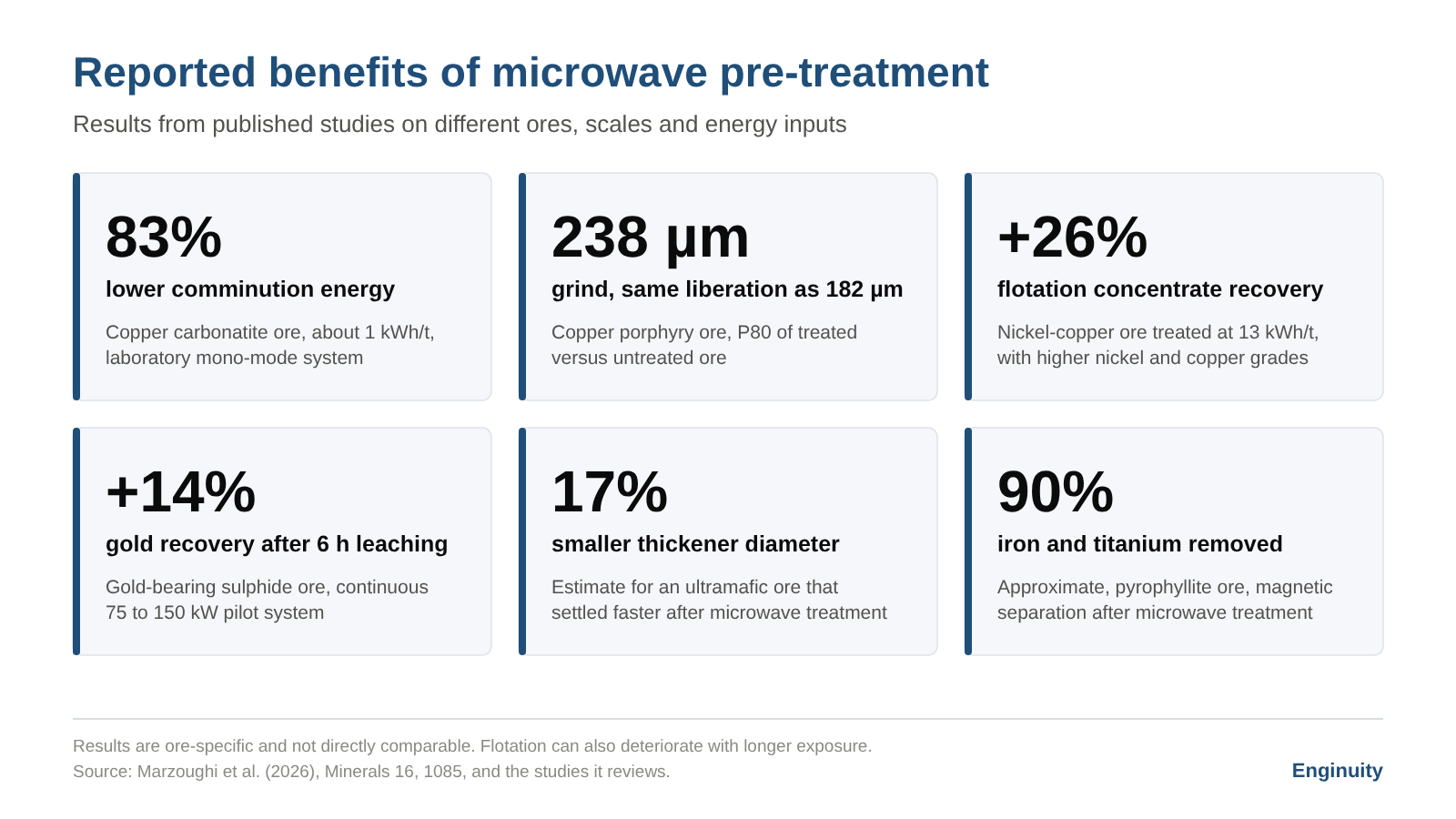
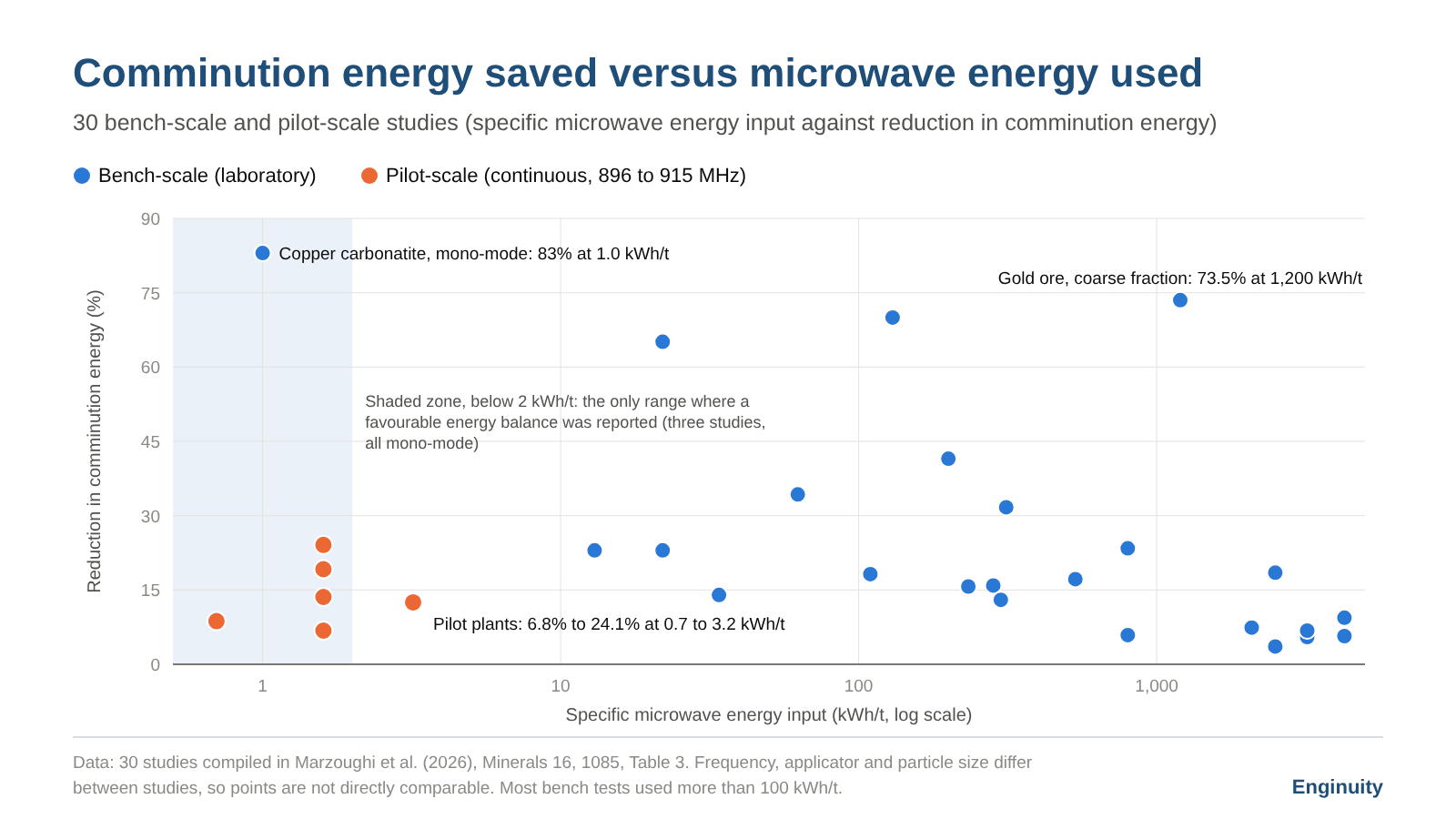
- Laboratory studies report up to 83% lower comminution energy; continuous pilots report 6.8% to 24.1% at 0.7 to 3.2 kWh/t.
- Liberation
- Treated copper porphyry ground to a P80 of 238 µm nearly matched the liberation of untreated ore ground to 182 µm.
- Best candidates
- Sulphide, porphyry copper, magnetite-bearing iron and carbonatite ores.
- Enginuity
- Microwave systems of 100 kW and 800 kW at 915 MHz, and a stage-gated ore testing programme.
How Does Microwave-Assisted Comminution Work?
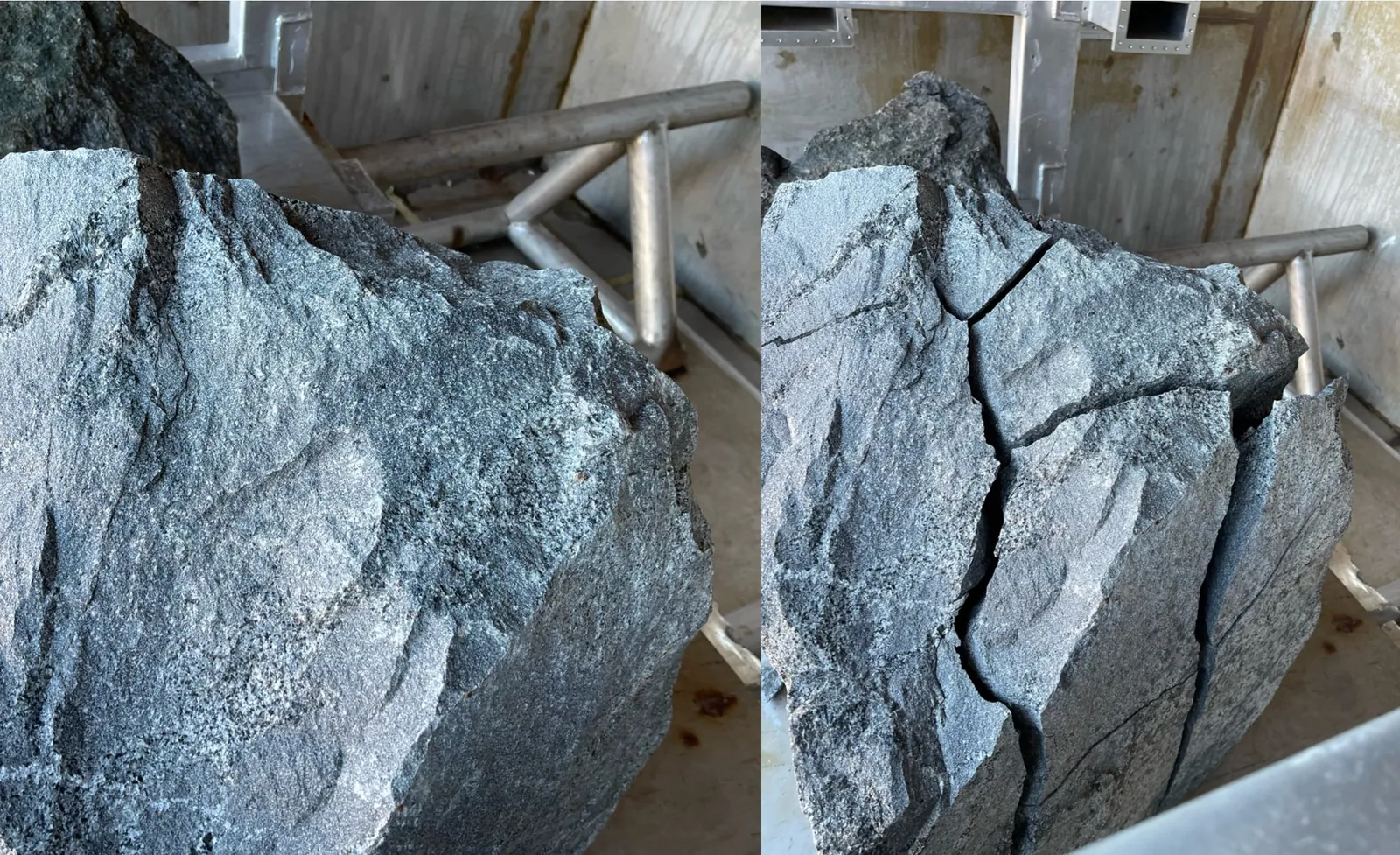
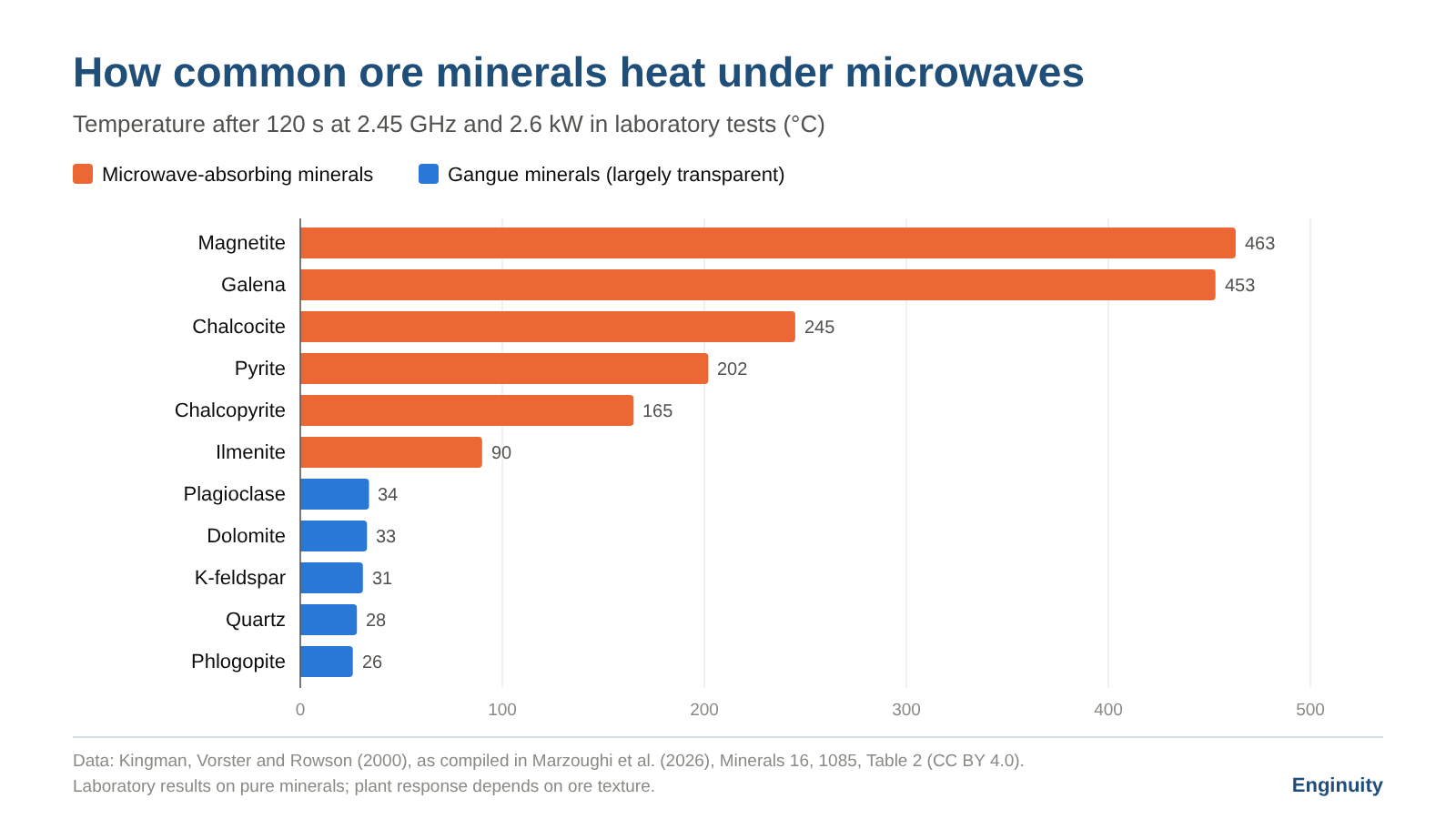
Microwave-assisted comminution uses microwave energy to weaken ore before crushing and grinding. In laboratory tests at 2.45 GHz and 2.6 kW for 120 s, galena reached 453 °C and chalcopyrite 165 °C, while quartz reached 28 °C (Marzoughi et al., 2026). The temperature difference creates thermal stress at mineral boundaries and promotes intergranular fracture, which separates valuable minerals from gangue. For the history of the technology and its use in excavation, see Microwave Technology in Mining: Excavation and Comminution Explained.
Which Ores Respond Best to Microwave Treatment?
Ore response is governed by the dielectric properties of its minerals rather than their hardness (Marzoughi et al., 2026). The strongest candidates are sulphide, sulphide-bearing porphyry copper, magnetite-bearing iron and carbonatite ores, where absorbing minerals sit in relatively transparent gangue. Quartz-rich ores, finely disseminated refractory ores and ores with little dielectric contrast respond weakly.
How Much Can Microwaves Reduce Comminution Energy?
Laboratory work on a copper carbonatite ore reported comminution energy reductions of over 30% at microwave inputs below 1 kWh/t (Kingman et al., 2004). A separate mono-mode study on the same ore type reported 83% at about 1 kWh/t (Marzoughi et al., 2026). Earlier US Bureau of Mines work cut the Bond work index of iron ores by 10% to 24%, but at an unfavourable energy balance (Walkiewicz et al., 1995). Pilot results are lower but use far less energy. A porphyry copper pilot at 896 MHz recorded an 8.7% reduction at 0.7 kWh/t, and a nickel-copper sulphide pilot at 915 MHz recorded 19.2% at 1.6 kWh/t (Marzoughi et al., 2026).
Does Microwave Treatment Improve Mineral Liberation?
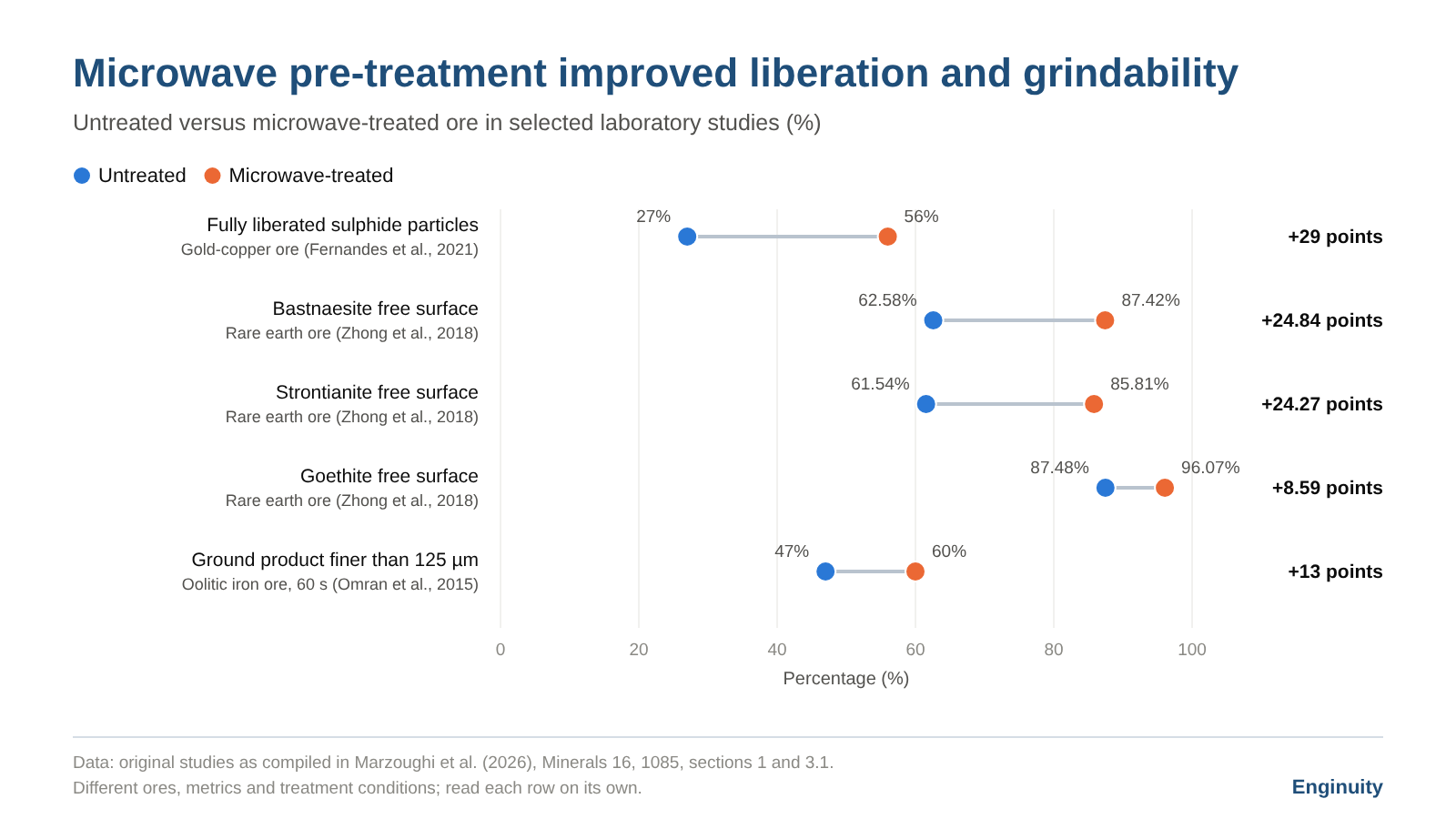
Yes, in many ores, because cracks along grain boundaries free valuable minerals at a coarser size. In copper porphyry ore, a treated sample ground to a P80 of 238 µm reached nearly the same liberation as untreated ore ground to 182 µm (Marzoughi et al., 2026). In a copper carbonatite ore, locked and middling copper sulphides in the +500 µm fraction fell from 69.2% to 31.8% (Kingman et al., 2004). University of Nottingham researchers have identified high-pressure grinding rolls (HPGR) and coarse particle flotation as integration routes (Marzoughi et al., 2026).
How Does Microwave Treatment Affect Flotation, Leaching and Dewatering?
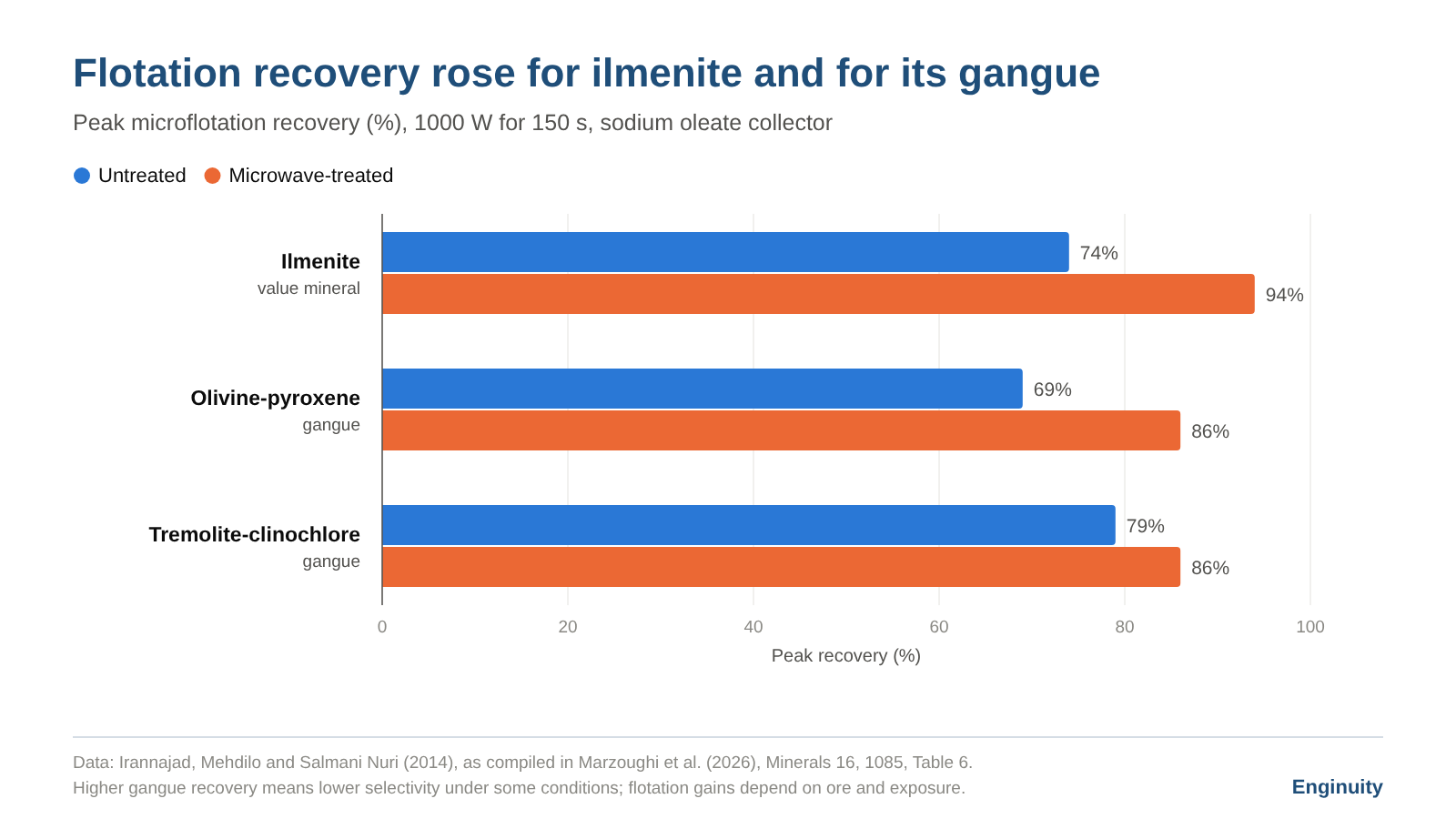
Downstream effects can be positive, but not always. In a nickel-copper ore treated at 13 kWh/t, flotation concentrate recovery rose by 26% (Marzoughi et al., 2026). Short irradiation improved sulphide floatability, while longer exposure oxidised mineral surfaces and reduced recovery. In a continuous pilot on a gold-bearing sulphide ore, gold recovery increased by 14% after six hours of leaching. Better settling of an ultramafic ore supported an estimated 17% reduction in thickener diameter (Marzoughi et al., 2026).
What Limits Microwave-Assisted Comminution?
A 2026 review of 30 bench and pilot studies found that most bench tests used more than 100 kWh/t. Only three reported a favourable energy balance, all below 2 kWh/t in mono-mode applicators, and a favourable balance alone does not prove economic viability (Marzoughi et al., 2026). Conductive sulphides can cause arcing, and higher throughput reduces the energy each tonne receives.
How Can Enginuity Help?
Enginuity (ENGN) is a multidisciplinary mining and engineering consultancy in Centurion, South Africa. It holds the largest publicly disclosed installed microwave capacity dedicated to mineral processing: 100 kW and 800 kW at 915 MHz, plus 6 kW at 2.45 GHz. A 2026 peer-reviewed review lists both 915 MHz systems among current field-scale hardware (Marzoughi et al., 2026). Enginuity's Microwave Amenability Test Programme (MATP) tests whether a specific ore benefits, from mineralogy screening to bulk validation on the 100 kW continuous system, with a go or no-go decision at each stage. Process teams can contact Enginuity to discuss feasibility testing for a specific ore.
Evaluating Microwave Pre-Treatment for Your Ore?
Enginuity’s Microwave Amenability Test Programme provides a stage-gated approach to determining whether a specific ore is suitable for further microwave pre-treatment evaluation.
Frequently Asked Questions
Continuous pilots report 6.8% to 24.1% lower comminution energy at 0.7 to 3.2 kWh/t. Laboratory studies report up to 83%, but only three of 30 compiled studies reported a favourable energy balance (Marzoughi et al., 2026).
It can. Recovery rose by 26% in one nickel-copper ore, but in laboratory tests, exposures of 10 to 20 s oxidised sulphide surfaces and reduced recovery, so exposure must be controlled (Marzoughi et al., 2026).
In one laboratory test, magnetite reached 463 °C, galena 453 °C, chalcocite 245 °C and pyrite 202 °C after 120 s. Quartz, feldspars and dolomite stayed between 28 °C and 34 °C (Marzoughi et al., 2026).
Coarse ore generally responds better. Several studies found stronger effects in coarser fractions (Marzoughi et al., 2026), so Enginuity treats ore at crusher product size, before the main grinding stage.
Technical review: Marco Delport, Pr.Eng, Managing Director, Enginuity.
Sources
- Kingman, S.W., Jackson, K., Cumbane, A., Bradshaw, S.M., Rowson, N.A. and Greenwood, R. (2004). Recent developments in microwave-assisted comminution. International Journal of Mineral Processing, 74. View source: Kingman, S.W., Jackson, K., Cumbane, A., Bradshaw, S.M., Rowson, N.A. and Greenwood, R. (2004). Recent developments in microwave-assisted comminution. International Journal of Mineral Processing, 74. (opens in a new tab)
- Marzoughi, O., Forster, J., Speck, R., Lee, S. and Pickles, C.A. (2026). Microwave-Assisted Mineral Processing: Mechanisms, Comminution Performance, Scale-Up, and Commercialization Challenges. Minerals, 16, 1085. View source: Marzoughi, O., Forster, J., Speck, R., Lee, S. and Pickles, C.A. (2026). Microwave-Assisted Mineral Processing: Mechanisms, Comminution Performance, Scale-Up, and Commercialization Challenges. Minerals, 16, 1085. (opens in a new tab)
- Walkiewicz, J.W., Lindroth, D.P. and Clark, A.E. (1995). Improved Grindability of Taconite Ores by Microwave Heating. US Bureau of Mines RI 9559. View source: Walkiewicz, J.W., Lindroth, D.P. and Clark, A.E. (1995). Improved Grindability of Taconite Ores by Microwave Heating. US Bureau of Mines RI 9559. (opens in a new tab)