Microwave Technology in Mining: Excavation and Comminution Explained
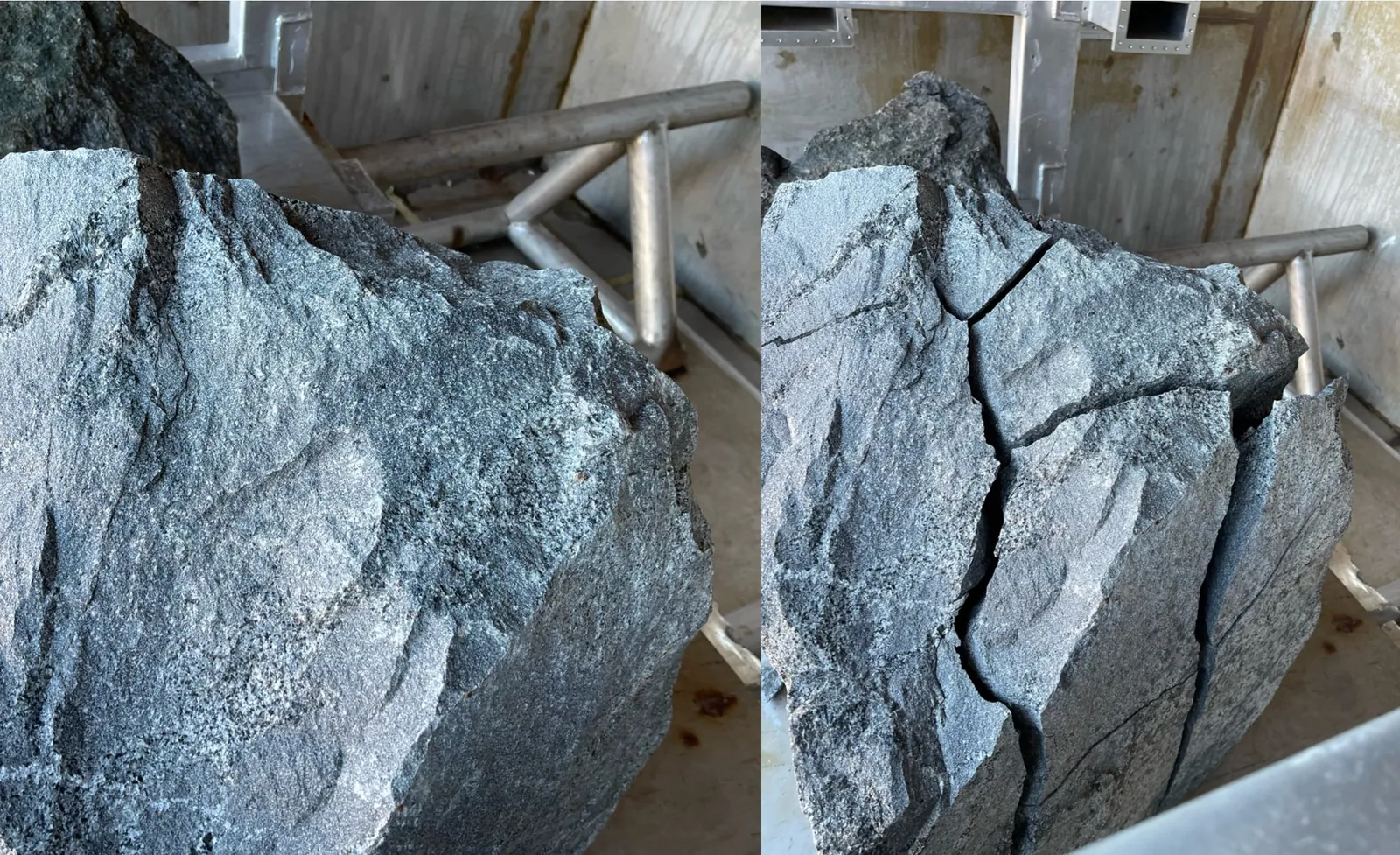
Microwave technology in mining uses high-power microwave energy, usually at 915 MHz, to rapidly heat the microwave-absorbing minerals inside ore or rock. The temperature difference cracks the material along grain boundaries, so it can need less energy to crush, grind, drill or cut. Research dates back to the 1950s, and pilot plants and field trials have now been run.
Key Takeaways
- How it works
- Microwaves heat absorbing minerals such as sulphides and magnetite, while most silicate gangue stays cool, creating cracks at grain boundaries.
- Comminution
- Laboratory work reports comminution energy reductions of over 30% below 1 kWh/t; pilot plants report 6.8% to 24.1% at 0.7 to 3.2 kWh/t.
- Excavation
- A 2024 field trial in a deep iron mine increased drilling speed by up to 66.5% after microwave treatment.
- Limits
- Results are ore-specific, and only three of 30 compiled studies reported a favourable energy balance.
- Enginuity
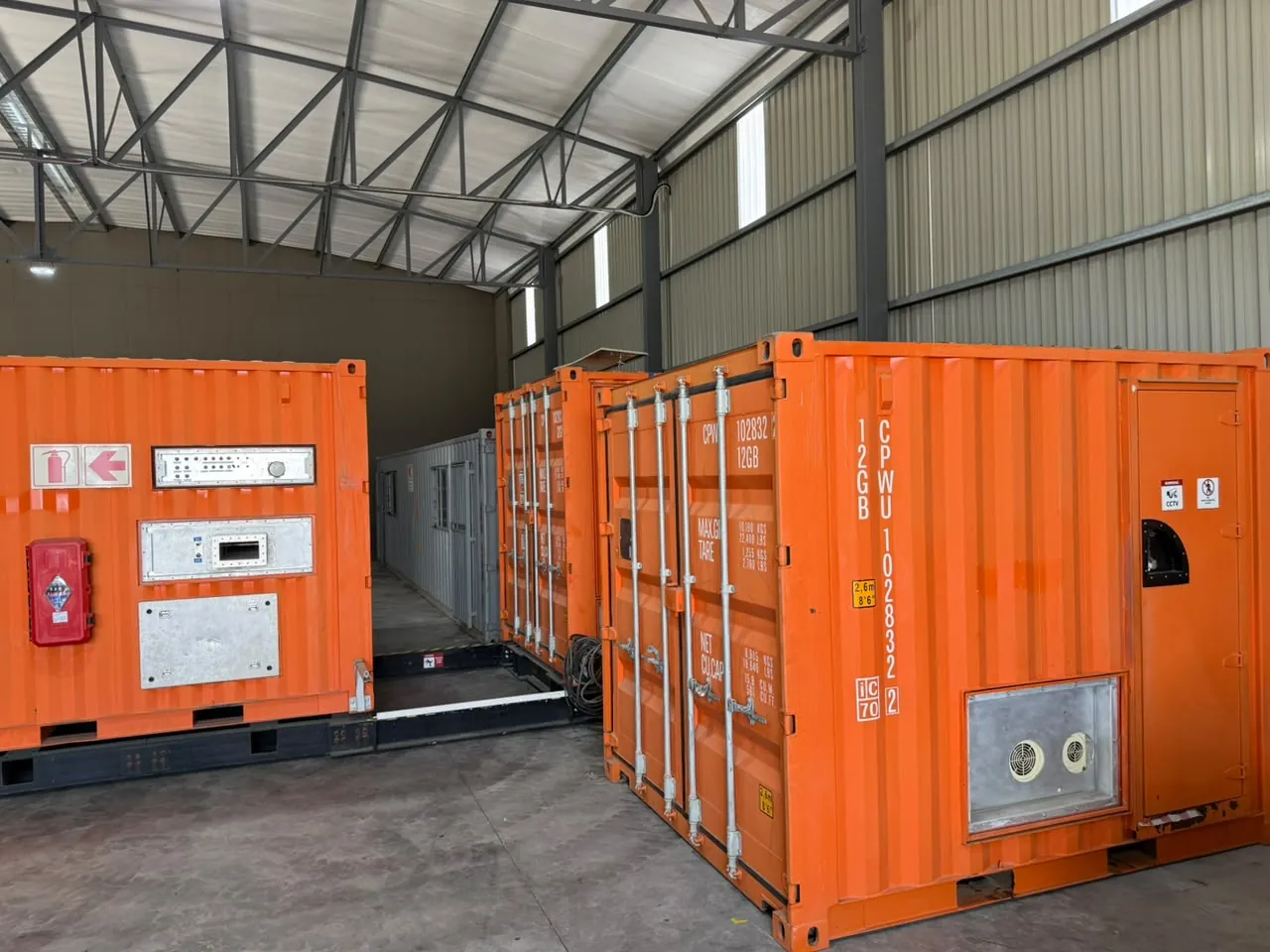
- Enginuity operates 100 kW and 800 kW microwave systems at 915 MHz, plus 6 kW at 2.45 GHz.
What Is Microwave Technology in Mining?
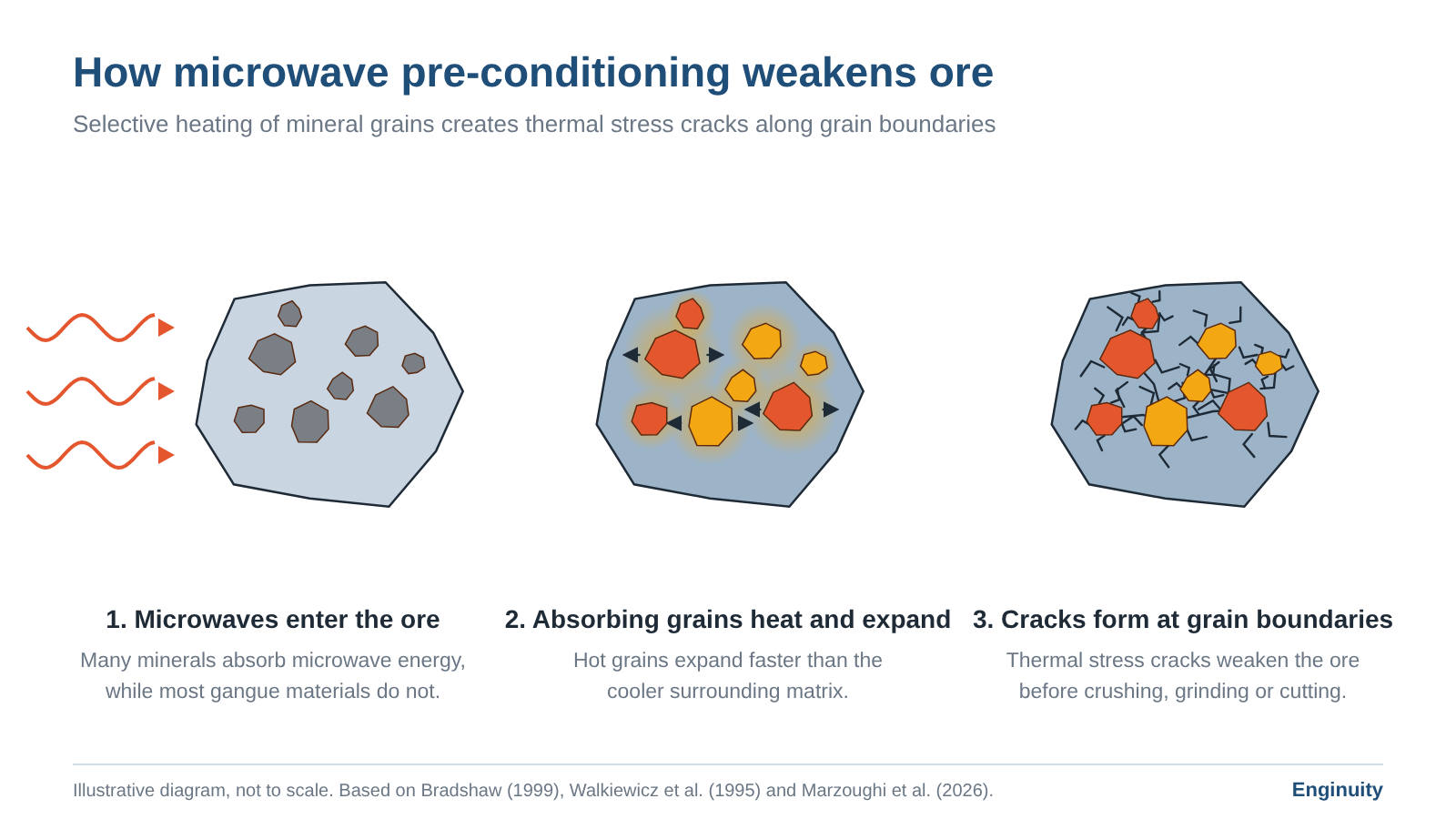
Microwave technology in mining is the use of electromagnetic energy to weaken ore or rock before it is broken. Many minerals absorb microwave energy, while most gangue materials do not (Bradshaw, 1999). The absorbing grains expand faster than the surrounding matrix, and the mismatch creates thermal stress cracks along grain boundaries (Walkiewicz et al., 1995). Laboratories mostly use 2.45 GHz, while pilot and industrial systems mostly use 915 MHz because it penetrates deeper (Marzoughi et al., 2026).
How Does Microwave-Assisted Comminution Work?
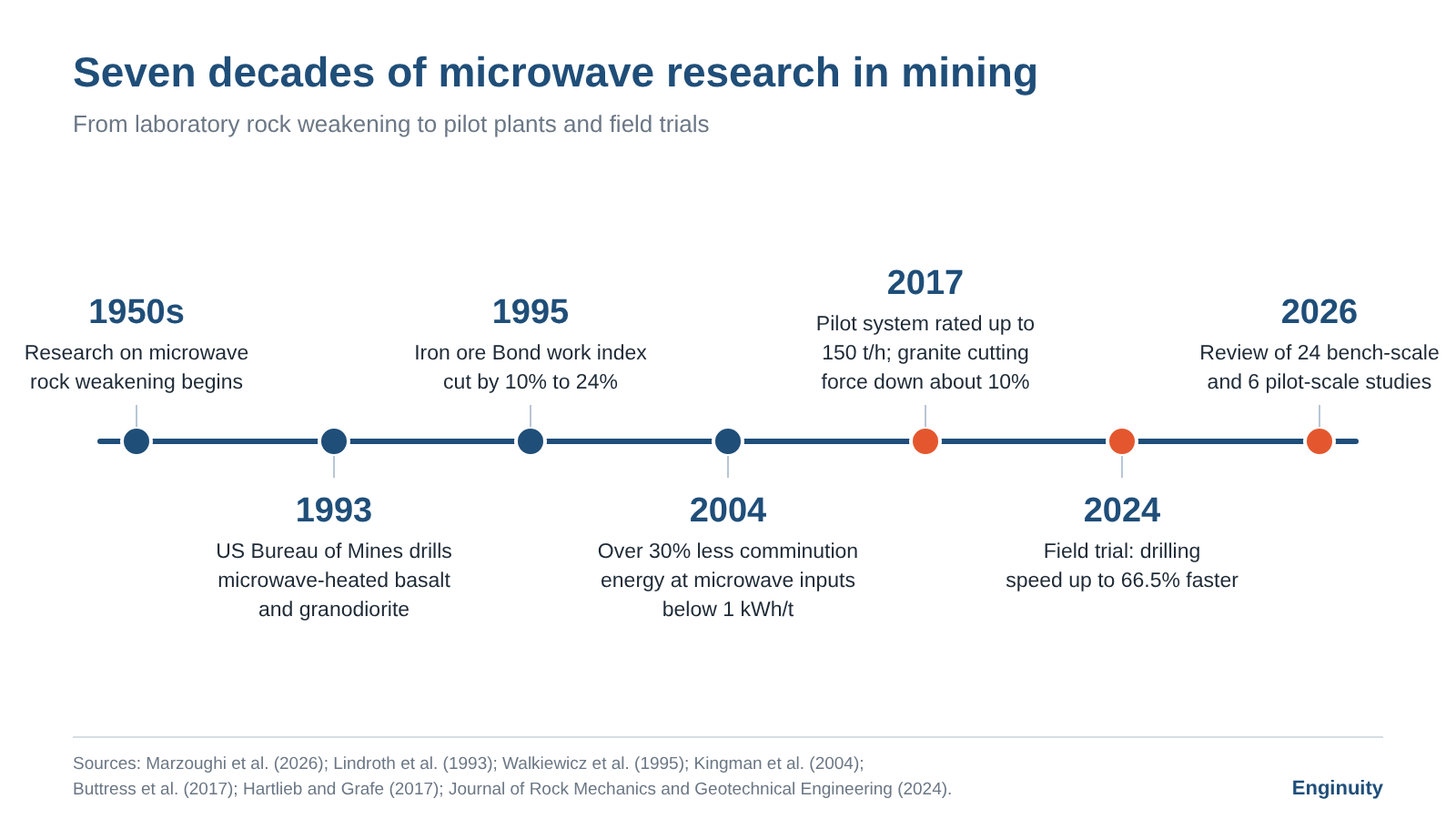
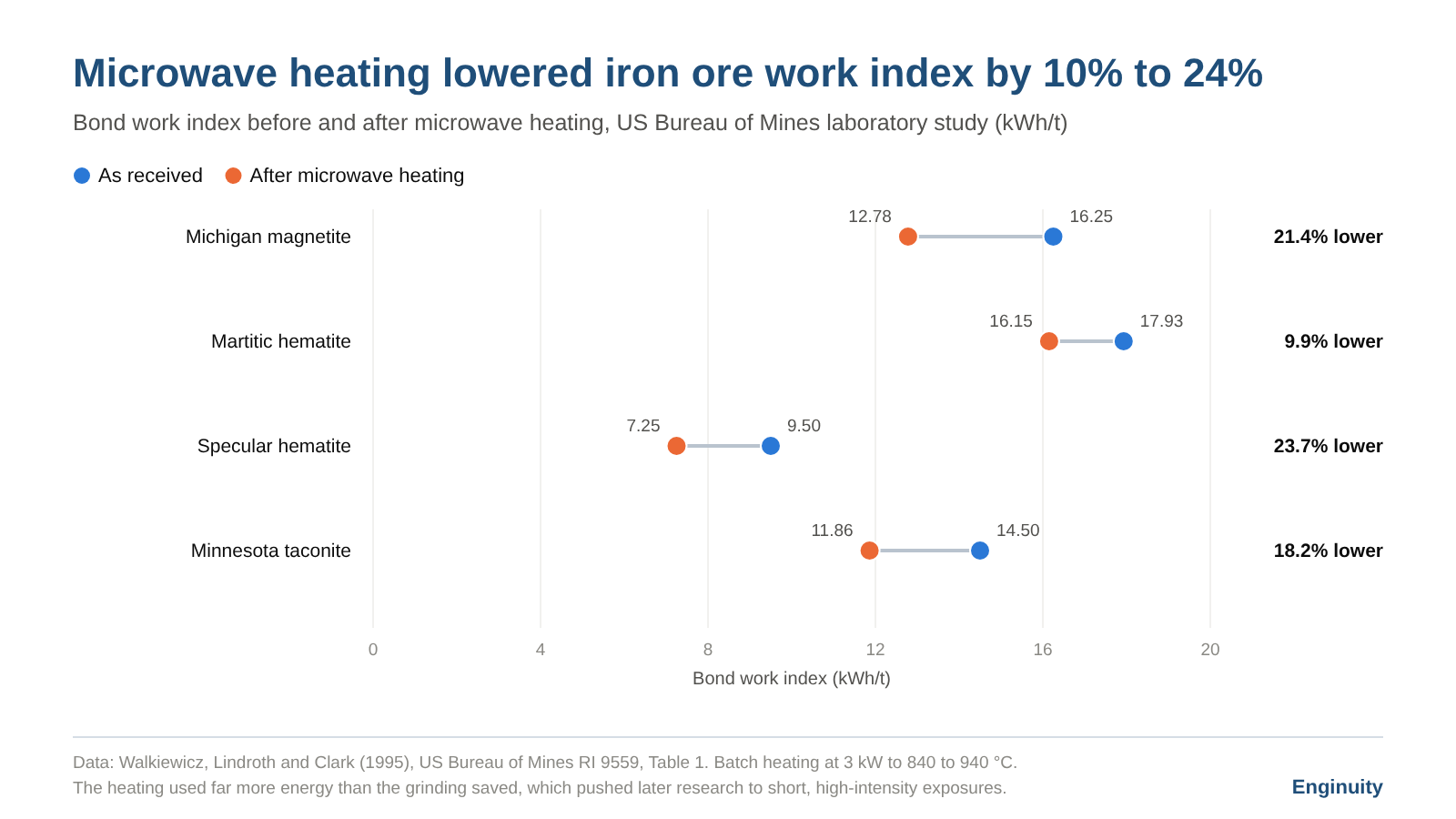
Microwave-assisted comminution heats ore briefly before crushing and grinding so that it breaks with less energy. The Coalition for Eco-Efficient Comminution (CEEC) states that up to 3% of global electrical energy is used in comminution. Research dates back to the 1950s (Marzoughi et al., 2026). A 1995 US Bureau of Mines study cut the Bond work index of iron ores by 10% to 24%, but the heating used far more energy than grinding saved (Walkiewicz et al., 1995).
Later work used short, high-intensity exposures. A copper carbonatite ore needed over 30% less comminution energy after microwave inputs below 1 kWh/t (Kingman et al., 2004). A pilot system rated at up to 150 t/h has since been built (Buttress et al., 2017), and continuous pilots at 0.7 to 3.2 kWh/t have measured lower comminution energy (Marzoughi et al., 2026).
Can Microwaves Be Used for Rock Excavation?
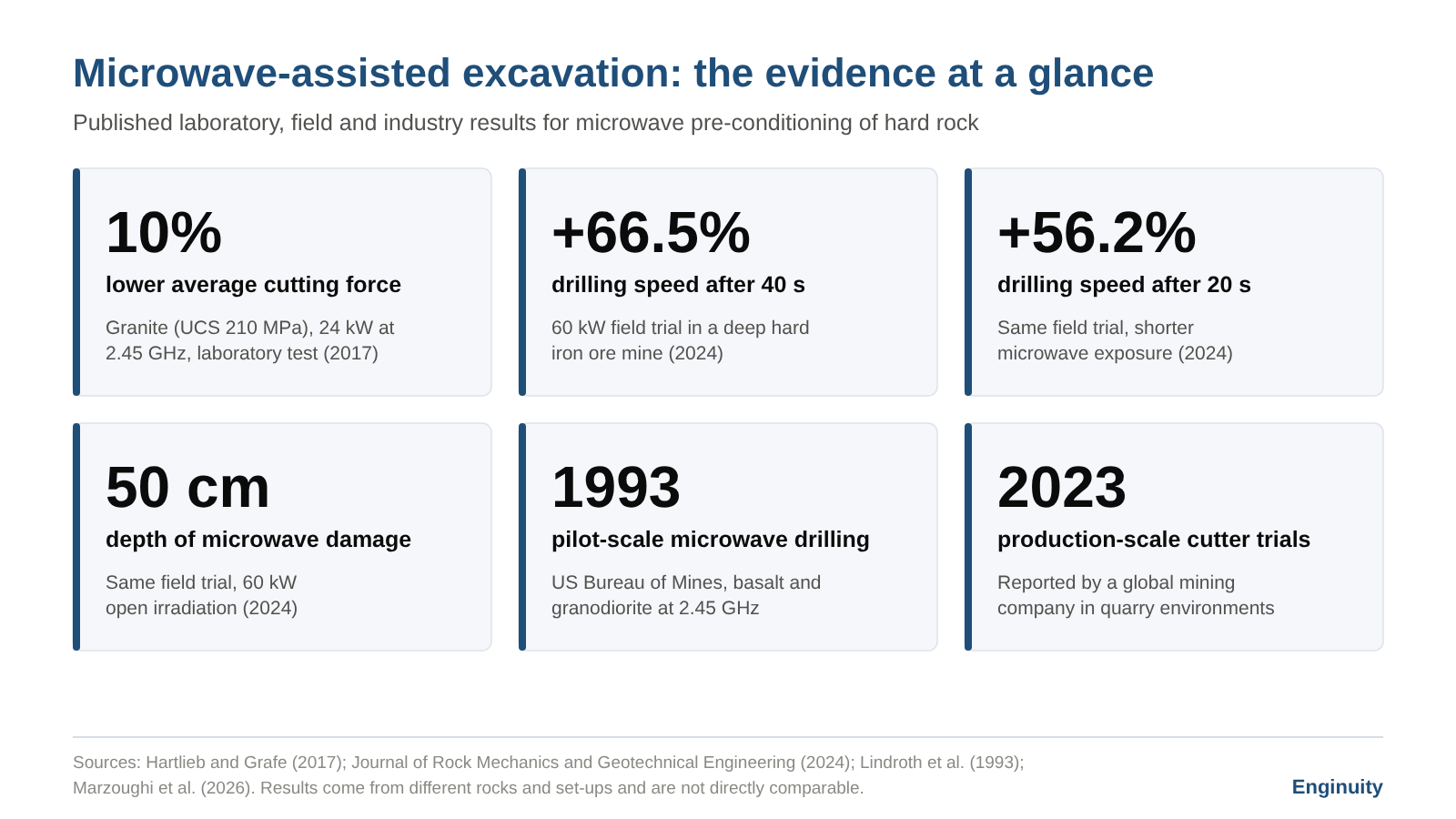
Microwaves can pre-condition hard rock before it is drilled or cut, using open-ended waveguide antennas aimed at the rock face (Marzoughi et al., 2026). US Bureau of Mines researchers drilled microwave-heated basalt and granodiorite in 1993 and reported penetration rates "well in excess of the state of the art" (Lindroth et al., 1993). In a laboratory test on 210 MPa granite, 24 kW at 2.45 GHz cut the average pick cutting force by about 10% (Hartlieb and Grafe, 2017). At the Sishanling iron mine, a 60 kW system damaged rock to a depth of about 50 cm and raised drilling speed by up to 66.5% (Journal of Rock Mechanics and Geotechnical Engineering, 2024). A global mining company has also reported production-scale cutter trials (Marzoughi et al., 2026).
What Are the Limitations of Microwave Technology in Mining?
Energy balance, ore variability and scale-up are the main limits. A 2026 review of 30 bench and pilot studies found that most bench tests used more than 100 kWh/t. Only three reported a favourable energy balance, all below 2 kWh/t (Marzoughi et al., 2026). Results depend on mineralogy, grain size and particle size, and industrial evidence is still mostly field demonstrations and company-reported trials.
How Does Enginuity Work with Microwave Technology?
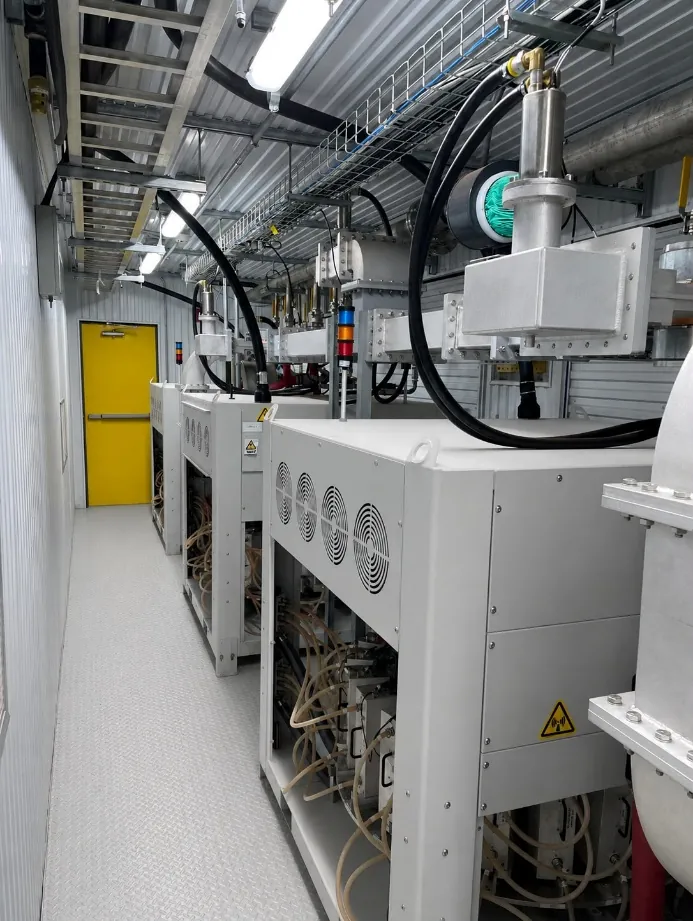
Enginuity (ENGN) is a multidisciplinary mining and engineering consultancy in Centurion, South Africa, delivering engineering, procurement and construction management (EPCM), detail design and research and development services. Enginuity holds the largest publicly disclosed installed microwave capacity dedicated to mineral processing: 100 kW and 800 kW at 915 MHz, plus 6 kW at 2.45 GHz. The 800 kW system is a modular solid-state fleet of four 200 kW containerised power blocks, and a 2026 peer-reviewed review lists both 915 MHz systems among current field-scale hardware (Marzoughi et al., 2026). Enginuity's Microwave Amenability Test Programme (MATP) tests whether a specific ore benefits, with a go or no-go decision at each stage. Mines and process engineers can contact Enginuity to discuss feasibility testing, research or a specific application.
Evaluating Microwave Technology for a Mining Application?
Enginuity’s Microwave Amenability Test Programme evaluates whether a specific ore may benefit from microwave treatment, with a go or no-go decision at each stage.
Frequently Asked Questions
Pilot and industrial systems mostly operate at 915 MHz (896 MHz in the UK), while laboratories mostly use 2.45 GHz. The lower frequency penetrates deeper, which suits coarse ore and high throughput (Marzoughi et al., 2026).
No. Ores respond best when microwave-absorbing minerals, such as sulphides or magnetite, sit in gangue that absorbs little energy. Quartz-rich ores, finely disseminated refractory ores and ores with little dielectric contrast respond weakly (Marzoughi et al., 2026).
Continuous pilot systems have measured lower comminution energy at 0.7 to 3.2 kWh/t. Most laboratory studies used more than 100 kWh/t, which is far more energy than grinding saves (Marzoughi et al., 2026).
Yes, in trials. A field trial in a deep iron mine raised drilling speed by up to 66.5% (Journal of Rock Mechanics and Geotechnical Engineering, 2024). A global mining company has reported production-scale cutter trials, although published industrial evidence is still mostly field demonstrations and company-reported trials (Marzoughi et al., 2026).
Technical review: Marco Delport, Pr.Eng, Managing Director, Enginuity.
Sources
- Bradshaw, S.M. (1999). Applications of microwave heating in mineral processing. South African Journal of Science, 95(9), 394 to 396. View source: Bradshaw, S.M. (1999). Applications of microwave heating in mineral processing. South African Journal of Science, 95(9), 394 to 396. (opens in a new tab)
- Buttress, A., Katrib, J., Batchelor, A., Jones, D., Craig, D., Royal, T. et al. (2017). Towards large scale microwave treatment of ores: Part 1, Basis of design, construction and commissioning. Minerals Engineering, 109. View source: Buttress, A., Katrib, J., Batchelor, A., Jones, D., Craig, D., Royal, T. et al. (2017). Towards large scale microwave treatment of ores: Part 1, Basis of design, construction and commissioning. Minerals Engineering, 109. (opens in a new tab)
- CIM Magazine (2021). New report highlights role of comminution in emissions reductions. View source: CIM Magazine (2021). New report highlights role of comminution in emissions reductions. (opens in a new tab)
- Hartlieb, P. and Grafe, B. (2017). Experimental Study on Microwave Assisted Hard Rock Cutting of Granite. BHM, 162(2), 77 to 81. View source: Hartlieb, P. and Grafe, B. (2017). Experimental Study on Microwave Assisted Hard Rock Cutting of Granite. BHM, 162(2), 77 to 81. (opens in a new tab)
- Journal of Rock Mechanics and Geotechnical Engineering (2024). Field test of high-power microwave-assisted mechanical excavation for deep hard iron ore. View source: Journal of Rock Mechanics and Geotechnical Engineering (2024). Field test of high-power microwave-assisted mechanical excavation for deep hard iron ore. (opens in a new tab)
- Kingman, S.W., Jackson, K., Cumbane, A., Bradshaw, S.M., Rowson, N.A. and Greenwood, R. (2004). Recent developments in microwave-assisted comminution. International Journal of Mineral Processing, 74. View source: Kingman, S.W., Jackson, K., Cumbane, A., Bradshaw, S.M., Rowson, N.A. and Greenwood, R. (2004). Recent developments in microwave-assisted comminution. International Journal of Mineral Processing, 74. (opens in a new tab)
- Lindroth, D.P., Berglund, W.R., Morrell, R.J. and Blair, J.R. (1993). Microwave-Assisted Drilling in Hard Rock. SME. View source: Lindroth, D.P., Berglund, W.R., Morrell, R.J. and Blair, J.R. (1993). Microwave-Assisted Drilling in Hard Rock. SME. (opens in a new tab)
- Marzoughi, O., Forster, J., Speck, R., Lee, S. and Pickles, C.A. (2026). Microwave-Assisted Mineral Processing: Mechanisms, Comminution Performance, Scale-Up, and Commercialization Challenges. Minerals, 16, 1085. View source: Marzoughi, O., Forster, J., Speck, R., Lee, S. and Pickles, C.A. (2026). Microwave-Assisted Mineral Processing: Mechanisms, Comminution Performance, Scale-Up, and Commercialization Challenges. Minerals, 16, 1085. (opens in a new tab)
- Walkiewicz, J.W., Lindroth, D.P. and Clark, A.E. (1995). Improved Grindability of Taconite Ores by Microwave Heating. US Bureau of Mines RI 9559. View source: Walkiewicz, J.W., Lindroth, D.P. and Clark, A.E. (1995). Improved Grindability of Taconite Ores by Microwave Heating. US Bureau of Mines RI 9559. (opens in a new tab)